
Before you buy the collection, verify the paper trail: probate authority, export permits, and the tiny inconsistencies lenders and insurers may question.
Probate language: read it like a hostile attorney

If you collect anything with real value, you already know the feeling: you open a folder that looks thick and official, and your brain wants to relax. Don't. Probate documents are where I see smart buyers get sleepy, because the pages feel like a source of authority. They are, but they're also full of narrow permissions that people over-read on purpose.
When a seller tells me, "We have probate," I still want to know exactly what the estate paperwork establishes before I treat the provenance file as settled. First, I want to confirm who has legal authority to act on behalf of the estate and whether any court order, will, or state-law restriction limits the sale. Probate powers differ by jurisdiction, so I don't assume that appointment papers alone answer every question. Second, I check whether the probate paperwork covers the actual asset described in the collector's packet. If an estate inventory describes a work broadly but a later sales listing gives it a firmer attribution, I want documentation showing how that attribution changed. That difference may reflect legitimate scholarship rather than an ownership problem, but it still deserves an explanation in the file. Third, I look for the date logic. A probate order dated after a purported private sale deserves an explanation, because the timing may raise questions about who had authority to sell at that point.
This matters whenever a valuable collection is part of your broader financial and estate planning. If you're insuring, selling, donating, or borrowing specifically against a valuable collection, provenance problems can trigger extra questions, delays, or additional documentation requests. That makes a clean ownership record worth sorting out before a transaction becomes urgent. Practical move: ask for the relevant probate order and any inventory, schedule, or exhibit identifying the property, plus current letters testamentary or letters of administration showing who is authorized to act for the estate. Then read it like you're trying to poke holes in it, because someone eventually will.
Export permits and customs stamps: match the object to the border
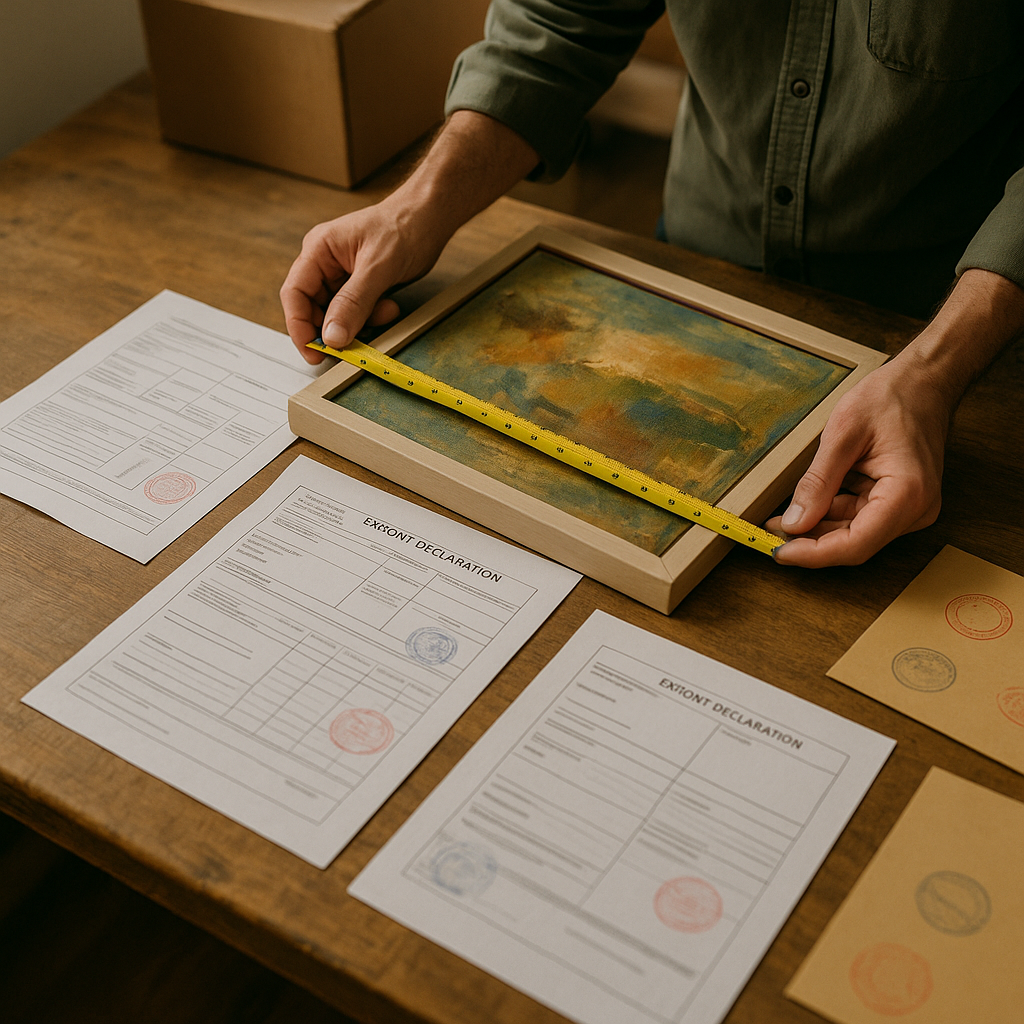
Export and customs paperwork deserves more than a glance. An old permit that describes a different object, even one by the same artist and from the same period, may not document the movement of the piece you are actually buying. On paper, that is not a rounding error. It's the difference between documented movement and mystery shipment.
So here's the check I run now whenever I'm evaluating an object with an international paper trail. I compare the relevant permit, customs declaration, or shipping document with the object itself. An ATA Carnet warrants separate treatment because it is primarily a customs document for the temporary import or export of goods intended for re-export. Dimensions deserve a careful check because discrepancies can result from transcription, measurement methods, or unit conversions, but they can also indicate that the paperwork describes a different object. Medium matters because mixed media can hide materials that trigger extra rules (ivory, certain woods, tortoiseshell, feathers). If the object contains ivory, tortoiseshell, feathers, protected woods, or other wildlife or plant material, I check which current rules apply, including CITES and potentially the Endangered Species Act, Migratory Bird Treaty Act, Lacey Act, or other federal and state restrictions.
Then I look at the stamps and the routing. A stamp tells you a form was processed, not that every fact on the form was true. If the route says Paris to New York, but the shipping invoices in the folder say Geneva storage for eight years, I want to know why the story skips that chapter. A gap isn't automatically fraud, but it can trigger harder questions during customs review, insurance underwriting, lending against the collection, or a future resale, especially when the missing history affects ownership or legal import.
For a serious collection, shipping, storage, insurance, and future international moves all make clean documentation more important. If the paperwork does not hold up to a careful line-by-line review now, inconsistencies may create additional questions during a later transaction or review.
Two files, one story: catch the tiny inconsistencies early

Here's a move that feels unglamorous, but it has saved me the most time: I build a one-page crosswalk that forces every document to tell the same story. Not a fancy database. A plain table with dates, parties, object description, and where each claim shows up (invoice, catalog entry, letterhead, shipping doc, insurance schedule). You'd be surprised how often the good file and the working file disagree.
The inconsistencies are usually small and totally human. A gallery changes its name, and the letterhead shifts. An estate uses a middle initial in one place and not another. A catalogue raisonné entry lists an alternate title. Those aren't inherently scary. The problem is when the small stuff clusters: a different year on the invoice than on the bill of lading, a different seller entity in the wire instructions than in the receipt, or a signature style that doesn't match the rest of the correspondence from the same office. When I'm building or expanding a valuable collection, I care because I'm relying on the assumption that the objects can be properly insured, appraised, financed, or resold. If those tiny mismatches exist, they may surface at the worst possible time, such as during an appraisal, an insurance review, a financing request, or a resale.
My favorite sanity check is to take the earliest and latest documents and read aloud only the proper nouns: names, locations, company entities, and dates. If I'm stumbling, a future counterparty will stumble too. If you plan to borrow against the collection, unresolved documentation questions may lead to additional due diligence, conditions, or delays.
If you're not sure what should match, you can start with the basics: a more specific description or attribution should ideally be supported by documentation explaining the change (attribution changes should come with supporting scholarship). For a major ownership event, I look for corroborating records when they exist and clearly flag any gaps or claims that rest on a single source. When everything lines up, the file has a calm, boring quality. That's the point.