
Three provenance checks I use to justify a premium: the paper trail, the catalog match, and the conservation report.
The paperwork stack that moves the number
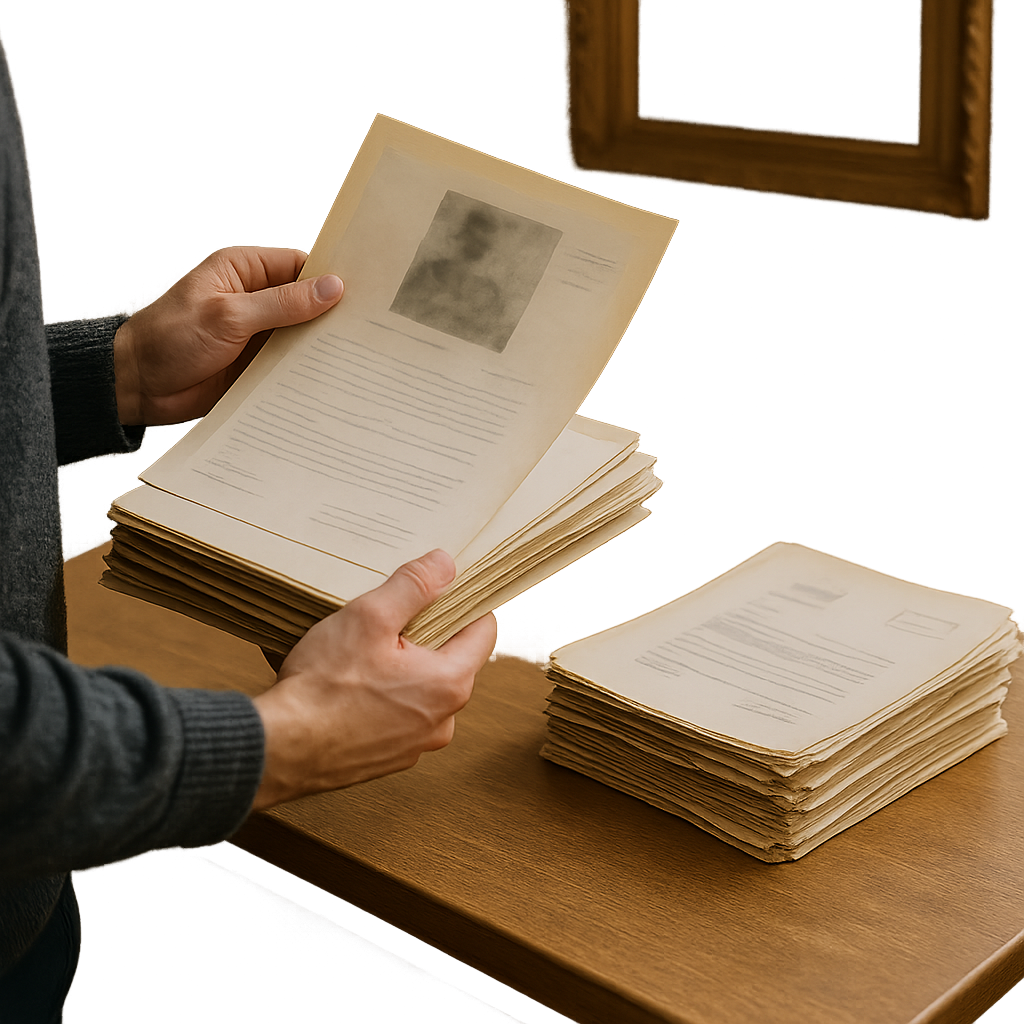
I used to think provenance was a polite appendix, the kind of thing you read after you fall in love with an object. Then I watched two near-identical pieces get appraised miles apart, and the one with a boring folder of documents came in higher without anyone even debating the condition. Same maker. Same materials. Same general era. The difference was that one had a tight chain of custody you could follow without squinting.
When I’m paying a premium, I want three categories of paper, and I want them to agree with each other. First is the basic chain: invoices, consignment receipts, bills of sale, and old shipping paperwork that includes names and dates. A single dealer invoice is fine, but it’s not a magic wand. What I’m looking for is continuity: the seller’s story matches the document trail, the dates don’t jump backward, and the names aren’t suspiciously generic. If you’re missing one link (it happens), you can sometimes shore it up with something adjacent like an insurance schedule entry or an email from a gallery that references the object specifically, not just “painting.”
Second is publication or exhibition support: a catalog entry, a label copy, a reference photo in an old collection binder. Even a grainy installation shot can matter because it places the object somewhere, at a time, with people who can be verified. Third is legal and ethical comfort: import/export permits where relevant, cultural property documentation if it’s in that lane, and any repatriation-related notes if the item category is known to be hot. None of this guarantees you’ll never have a problem, but it changes the valuation conversation from vibes to evidence. Appraisers and serious buyers don’t just ask, “Is it good?” They ask, “Can I resell it without a headache?” That question has a dollar sign attached.
Catalog raisonne cross-checks I do before I believe a story

Here’s the part that feels fussy until you do it once and save yourself: I don’t let a provenance claim live only in a seller’s description. If an object is the kind of thing that gets tracked, I go hunting for the track. For fine art, that often means a catalog raisonne or at least a serious reference book that lists known works, editions, or variants. For watches, it might be archive extracts and production ranges. For rare books, it can be bibliographies, prior auction records, and binding notes that a specialist would recognize. Different markets, same move: find the reference point that the market treats as a backbone.
My cross-check is practical, not academic. I’m looking for a match on the stuff that’s hard to fake consistently: measurements, medium, edition size, inscription wording, and provenance names spelled the same way. I’ve seen “close enough” listings where the size is off by half an inch and the seller shrugs like it’s nothing. It’s not nothing. That’s the kind of mismatch that turns into a pricing haircut because now you’re paying for uncertainty. If the catalog lists a work as 24 x 30 in and your piece is 23 1/2 x 29 3/4 in, that might be framing, sight size, or rounding, or it might be an entirely different work. You don’t assume; you resolve it.
I also check the negative space around the story. If someone says, “From a private European collection,” I want at least one anchor: which collection, which city, which decade, what was the route into the current market. Vague claims don’t just annoy me. They affect valuation because they don’t transfer well. The next buyer can’t repeat the story without sounding like they’re hiding something. If you can tie the object to a documented sale (a known auction house record, a catalog illustration, an exhibition checklist), you’re not just verifying authenticity. You’re increasing liquidity. And liquidity, in my experience, is what keeps the premium from evaporating the moment you decide to sell.
Condition reports and conservation notes: the provenance people ignore

I’m going to say something that bothers people who love a dramatic backstory: a boring condition report is part of provenance. Not in the romantic sense, but in the money sense. If I’m evaluating a premium price, I don’t only want to know who owned it. I want to know what happened to it while they owned it, and whether those interventions are documented clearly enough that the next buyer won’t assume the worst.
In practice, that means I ask for any conservation reports, restoration invoices, and prior condition reports from auction houses or appraisers. When I can get them, I read them like I’m going to have to defend the value to a skeptical insurer. Specific notes help: “cleaned and varnish removed in 2008,” “hinges replaced,” “dial refinished,” “rebacked,” “stabilized crack,” “replaced crystal,” “repaired tear,” “overpaint present along edge.” Those phrases can move the valuation up or down depending on the category and the quality of the work, but the big swing comes from whether it’s documented and competent. A well-done conservation treatment with a reputable conservator’s write-up is a lot easier to underwrite than a mystery fix that someone did in a basement with a kit.
One of the most expensive misunderstandings I see is when sellers treat restoration as if it’s either a shameful secret or a selling point on its own. It’s neither. It’s part of the object’s biography, and it affects what knowledgeable buyers will pay because it affects risk. If a report says the work is stable, materials are reversible where appropriate, and the treatment is described in plain language, you can price with confidence. If there’s no documentation and the item shows signs of intervention (fresh screws, uneven patina, a too-new backing board, tool marks), the premium gets harder to justify because now the buyer has to budget for unknowns. You can love the object and still demand the paperwork that keeps your resale story clean.