
When executives invest personal capital alongside a private-equity sponsor, three issues deserve scrutiny: fee math, control drift, and what happens after the first add-on closes.
The management fee math nobody wants on the whiteboard
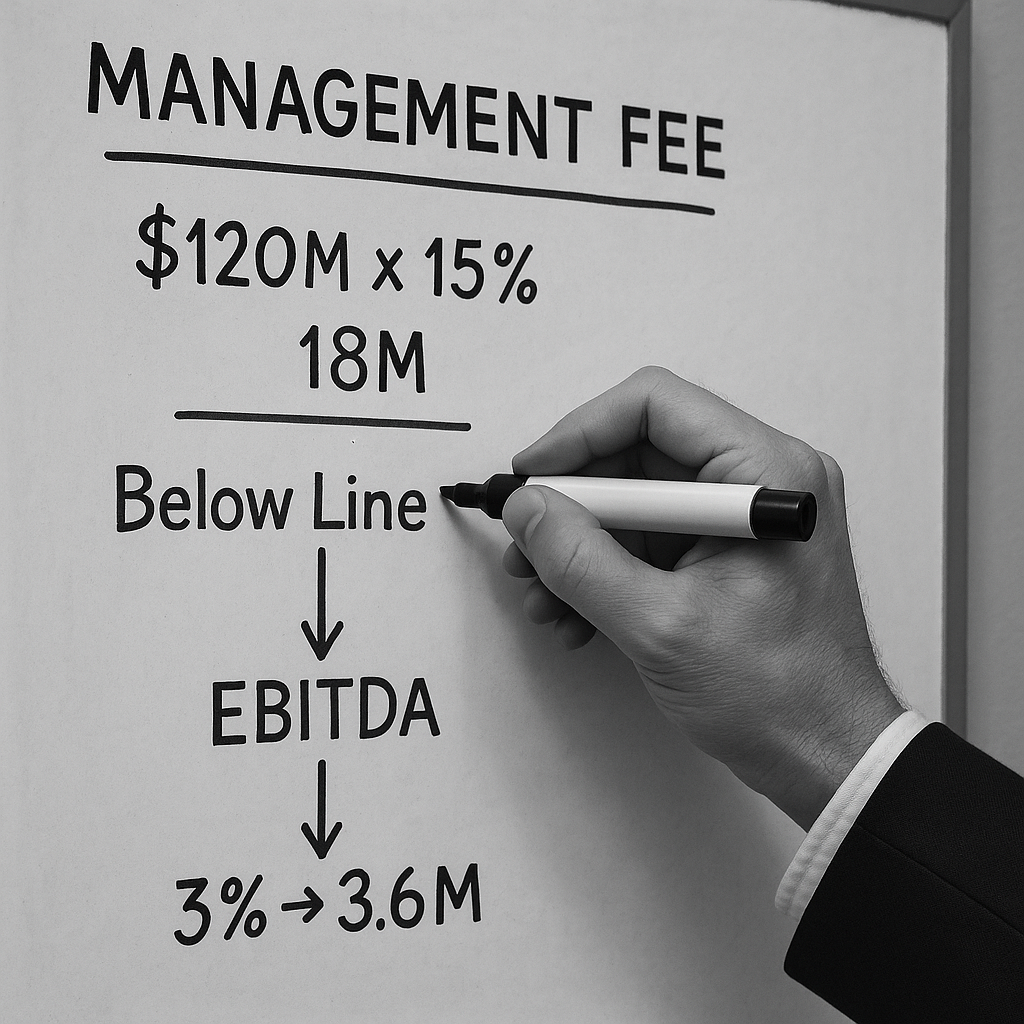
I have watched more partnership conversations go sideways over a spreadsheet tab labeled something like Fees_v3 than over valuation. Not because the numbers are huge in any one row, but because nobody wants to do the uncomfortable part out loud: trace where the dollars go before they ever become EBITDA, let alone equity value.
When a sponsor says, in passing, that the platform will pay a management fee, I ask for the exact formula and the base. Is it a percent of revenue, EBITDA, or invested capital? Does it step down after a leverage milestone? Does it persist after a recap? If the answer is a shrug and a promise to "circle back," that's your cue to slow the whole train down. In a real operating company, that fee line hits the same P&L that funds headcount, product, and retention comp. It's not an abstract concept. It's payroll you didn't make.
Then I push for a simple back-of-the-napkin translation: if the platform generates $120M in revenue at a 15% margin, what does the fee do to free cash flow after interest, taxes, and required capex? I want the sponsor's team to write it on a whiteboard, not hide it inside a model. The room's posture changes when people see that a 3% fee on revenue is not "3%." It's sometimes the difference between keeping a second plant shift and cutting it. If you're the CEO, that means you're the one explaining the cut, even though you didn't invent the fee.
Finally, I ask how fees behave once add-ons start. A lot of executives get excited about the first acquisition, then realize every bolt-on comes with its own transaction fees, integration costs, and sometimes a new monitoring fee. If the partnership assumes a constant cost structure while layering on fees, it's going to feel like you're running uphill in dress shoes. I don't need a lecture on alignment. I need the arithmetic, cleanly, with examples.
Control drift: the board seat that quietly becomes a steering wheel

Early meetings are always friendly. The deal team is excited, the bankers are glowing, and everyone keeps saying the word partner like it has legal force. The first time you find out what control really looks like is usually when you miss a quarter, have a refinancing conversation, or a key executive departs. That's when we're aligned turns into: who can approve what, on what timeline, with what consequences.
What I look for isn't a single scary clause. It's the slow creep of decision rights. Start with the obvious list: annual budget, hiring or firing the CFO, acquisitions, debt incurrence, and equity issuance. Fine. Then go one level deeper into the stuff that makes a CEO's week miserable: entering a new customer contract above a threshold, changing pricing, changing commission plans, closing a facility, signing a new lease, switching ERP vendors. If those are all buried under a broad consent right, you'll be asking permission to run your business, and you'll be doing it in a Monday board call with six people who weren't in the customer meeting.
I also ask how the board works in practice. Do they have an operating partner who shows up on site, sits in on pipeline reviews, and knows why your best SDR is threatening to quit? Or is the value creation support a quarterly slide deck that arrives after decisions have been made? I have lived both. One is helpful pressure. The other is overhead with opinions.
Here's a small tell: when you ask for examples of prior board disagreements, do they answer with a real story or with polished principles? I'm not looking for drama. I'm looking for evidence that the sponsor can disagree without turning it into a referendum on management. If the only thing they can describe is harmony, you're not being shown the full movie.
These control rights matter even more when an executive has invested substantial personal wealth in the deal. If your personal net worth in the deal is meaningful, you negotiate these rights differently because you know you're the one absorbing the blow when control tightens. You're not posturing. You're protecting your downside while still chasing the upside.
Your second bite of equity gets priced the moment the first add-on closes

Most executives focus on the first check. I get it. It's the headline moment: cash at close, some rollover, a management incentive plan that looks generous on the summary page. Then the platform buys its first add-on and, suddenly, you realize your second bite of the apple is being priced by mechanics you didn't interrogate when everyone was celebrating.
I like to map out ownership as if I'm explaining it to a smart friend who hates finance. Who owns what on day one, fully diluted? How big is the option pool and who controls refresh grants? When the add-on comes in, is it paid in cash, debt, or equity? If equity is part of the currency, whose equity is it? Platform equity issued at the current valuation can be fine. Still, it tends to become a quiet dilution machine if you aren't monitoring the fully diluted cap table after every transaction.
And don't skip the boring mechanics: is your rollover the same security as the sponsor's, or are you holding a different security with different rights? I've seen management roll into a class that looked equivalent until you read the distribution waterfall and realized certain fees and preferred returns get satisfied before common sees a dime. Nobody needs a law degree to spot the practical risk. If cash distributions are unlikely unless everything goes perfectly, your alignment is mostly theoretical.
The other thing that gets fuzzy fast is how your personal liquidity works between entry and exit. If your wealth outside your W-2 is concentrated in this one position, you'll care a lot about whether there's any path to partial liquidity (a structured secondary, a recap, even a small sell-down) that doesn't require begging. Some sponsors are allergic to it. Some are pragmatic. The key is learning which one you're dealing with before you're six quarters in and tired.
In my experience, the best partnership conversations include a plain, unglamorous ritual after every deal event: updated cap table, updated incentive plan schedule, and a quick walk-through of what changed. Ten minutes. No theatrics. Just facts. If that rhythm isn't welcome, you're going to feel the surprise later.