
Top executives investing in private equity often pursue fee-light co-investments while using side-letter protections and Quality of Earnings reports to manage the risks behind those personal checks.
Co-investment allocations (and the calendar games around them)

Experienced investors examine the sponsor’s allocation practices before assessing the deal itself. The pitch always starts with the same line, no management fee, no carry, direct exposure alongside the sponsor. Fine. The part that matters is whether the GP uses co-invest to reward the LPs who make their fundraise painless, or to quietly offload the parts of a deal they can't (or don't want to) hold at the fund level because of concentration limits, lender dynamics, or timing.
Experienced executives often treat co-investment access as a relationship asset they must earn and protect. They show up as a reliable check when the sponsor is running a tight timeline, which sounds glamorous until you're wiring a meaningful amount on a Thursday because the purchase agreement is signing Monday. In practice, the data room is organized, but the memo arrives late, and the deadline for your subscription docs is earlier than you want it to be. A compressed timeline is not automatically a warning sign, but it leaves little room for unstructured decision-making. Executives therefore need a clear screening process before an opportunity arrives.
The first question is why the co-investment opportunity exists. Investors should determine whether the additional capital supports a faster closing or shifts excess exposure away from the main fund. Investors should also ask how much of the co-investment is already committed, because a $50 million allocation with only $8 million remaining may function more like a favor program. Investors should request the capitalization table and the planned equity split between the main fund and the co-investment vehicle. A reputable sponsor can share it, at least in ranges, without acting like you're asking for state secrets.
Strong co-investment opportunities usually come with clear, verifiable financial information. You get a model you can tie to the IOI/LOI assumptions, you get a debt term sheet, and the return bridge isn't hand-wavy. The worst ones have a gorgeous story and a lot of "we'll update" language, plus an implied social pressure to move fast because, well, you're lucky to be invited.
Side letters that turn a blind pool into something you can live with

Most people hear side letter and assume it's a fee discount. Sometimes it is. Experienced executives may value a more practical form of protection: side letters that force information, timing, or process discipline when the fund documents leave too much wiggle room. If you're writing seven figures into a blind pool, you want to know what you'll see, when you'll see it, and what happens if the GP changes the rules midstream.
The following side-letter provisions can become especially valuable when a fund encounters difficulties:
- Enhanced reporting that goes beyond glossy quarterly slides. Investors should request company-level KPIs for major positions and a consistent comparison between budgeted and actual results. If the sponsor uses operating partners, investors should receive a summary of their involvement rather than a vague statement that additional resources were provided.
- Notice rights for key events. Not permission, just notice. Material litigation, a breach under a credit agreement, a CFO departure at a top holding, an add-on that changes the leverage profile. These are the moments where waiting for the next quarter is how you get surprised.
- A clearly written most-favored-nation provision that allows investors to access more favorable terms granted to comparable participants.
For executives investing personal capital, these provisions preserve flexibility without creating the illusion of complete control. Side letters are one of the few tools that let a smaller check behave more like an institutional one.
In practice, if you're asking for anything that creates actual operational burden, you'll get pushback. Requests should therefore remain focused and easy to administer. Side letters should serve a clear protective purpose rather than function as a display of negotiating power. Without those protections, investors may face a down quarter where the IR team goes quiet, the board decks are suddenly confidential, and you're left reconstructing what happened from three sentences in a letter. Clear reporting obligations established at the outset can reduce that uncertainty.
How Executives Can Read a Quality of Earnings Report
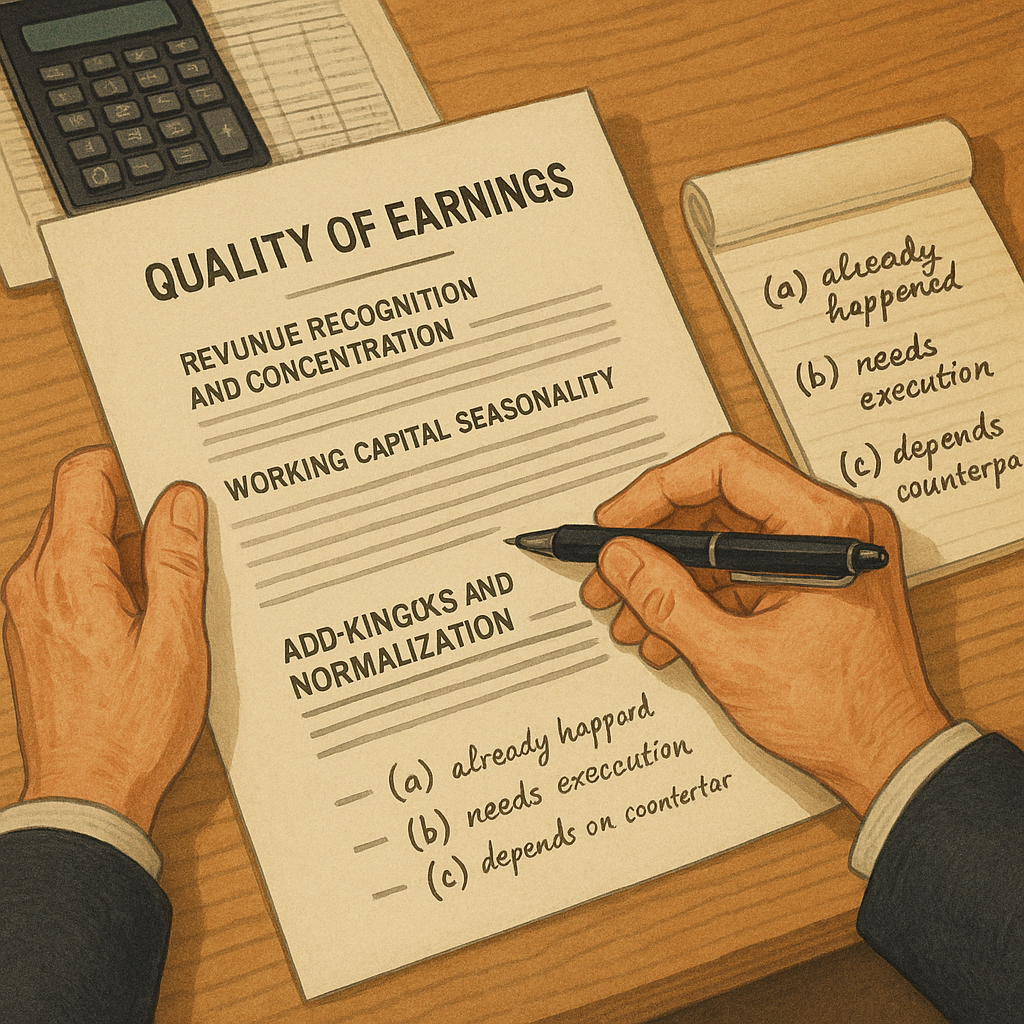
If you're an exec writing a personal check into a sponsor-led deal, you're usually not in the diligence seat. You're not interviewing the controller, you're not re-building the revenue schedule, and you're not the person making the call on whether the add-backs are aggressive. However, the report can still reveal whether the company’s reported earnings are sustainable.
Rather than relying only on the summary, investors should examine the sections showing whether performance reflects a durable business or an unusually strong reporting period. Three areas deserve particular attention:
- Revenue recognition and concentration. I scan for any language about cut-off issues, bill-and-hold, channel stuffing, or unusual quarter-end shipping patterns. Then I look at customer concentration and churn notes. If a top customer changed terms, that's not trivia. It's the story.
- Working capital seasonality. Although investment materials may emphasize EBITDA, investors and lenders must also understand how reliably those earnings convert into cash. The QofE will usually flag whether the target needs a permanent working capital investment to grow, or if the model assumes a magical release. I read the net working capital peg discussion like it's a legal document, because it basically is.
- Add-backs and normalization. This section can materially affect the valuation. I want to know which adjustments are one-time in a way that won't repeat, and which ones are more like wishful thinking with a memo behind them. If I see lots of vague buckets, I slow down.
A useful approach is to create a one-page summary that rewrites adjusted EBITDA in plain English, line by line, and classifies each adjustment as (a) already achieved, (b) dependent on execution, or (c) reliant on a counterparty. The final category may carry the greatest risk, especially in roll-up strategies where every add-on is immediately accretive until integration hits.
Investors should also identify who prepared the Quality of Earnings report and whether it was commissioned by the buyer or the seller. Neither type is automatically unreliable, but the commissioning party should influence how closely the assumptions are examined. Executives do not need to become forensic accountants. The goal is to avoid investing on the basis of projections that are not supported by sustainable earnings.